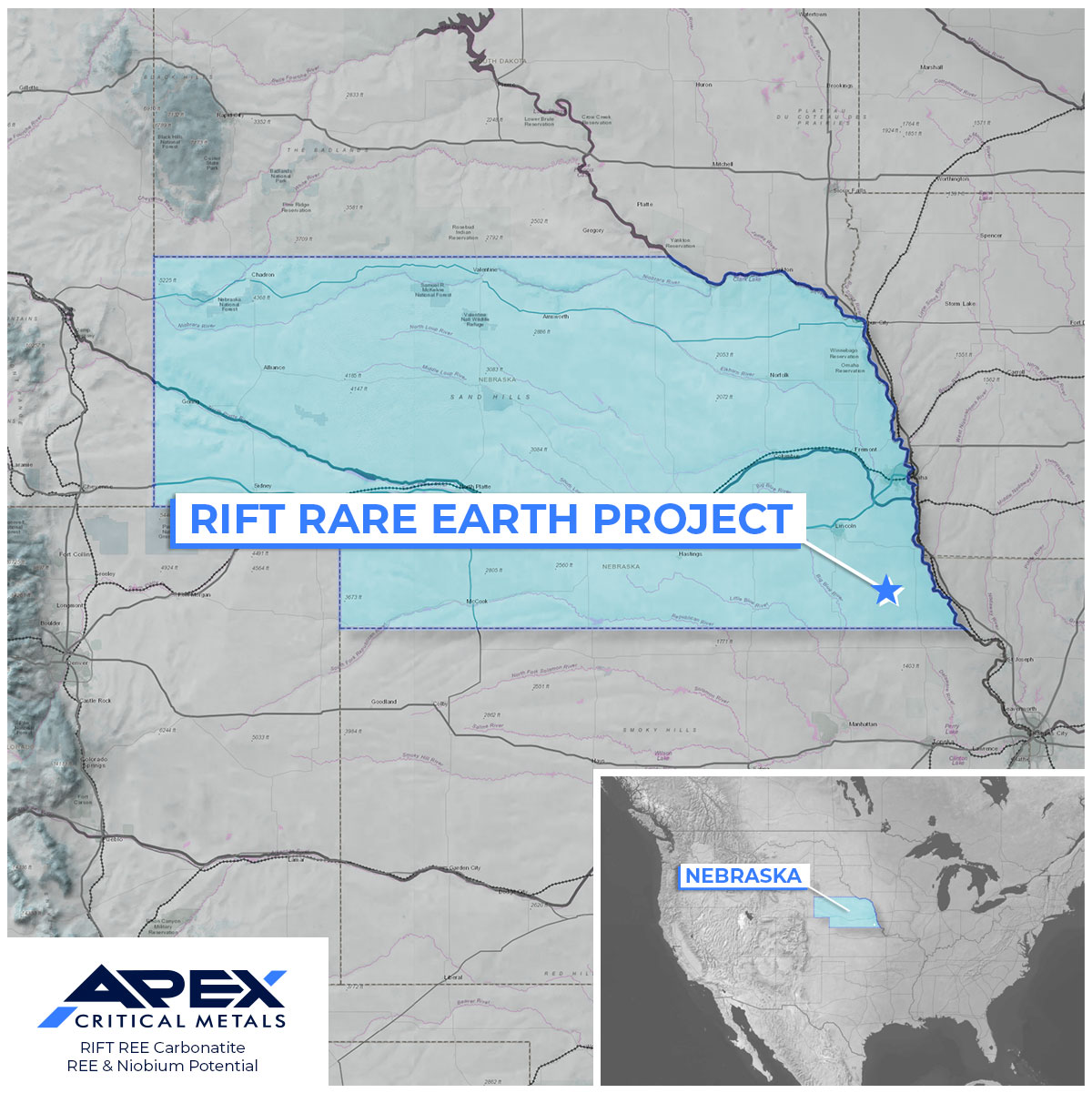
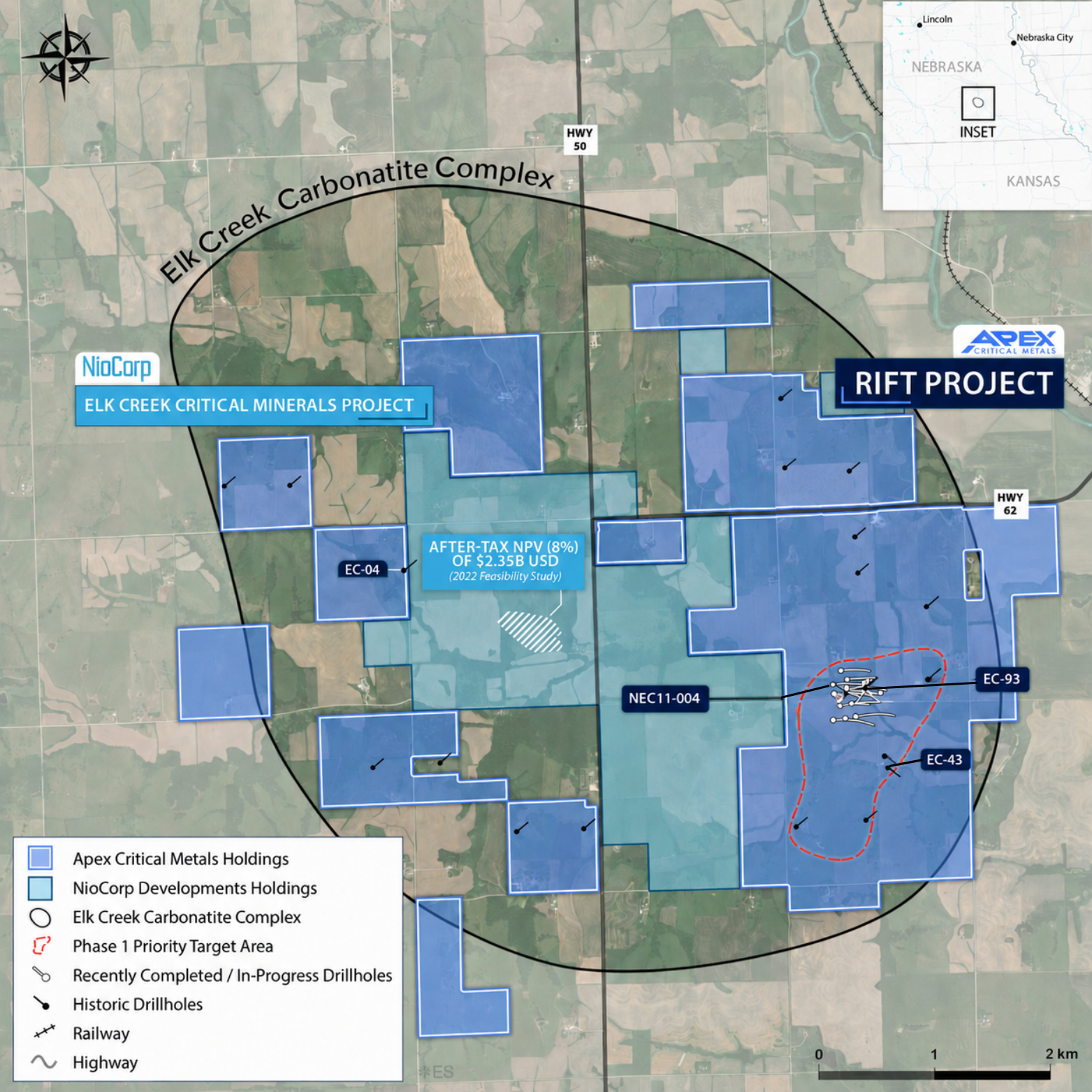
The Rift REE Project is a globally significant rare earth and niobium project located in southeastern Nebraska, USA, at the highly prospective Elk Creek Carbonatite Complex near the village of Elk Creek. With a diameter of 6–8 km, it ranks among the largest carbonatite bodies in the world. The project is positioned within a Tier-1 jurisdiction, offering excellent infrastructure and geopolitical stability.
Two target areas (East Zone and West Zone) include multiple historical drill holes that are well-mineralized in REE’s.
Location & Geology
Region: Southeastern Nebraska, ~100 km from Lincoln.
Geology: Rare alkaline intrusive complex emplaced ~500 million years ago.
Host Rocks: Carbonatite intruding Proterozoic gneiss, overlain by ~200 m of sediment.
Mineralogy:
Niobium: Hosted in magnetite beforsite.
REEs: Hosted in barite beforsite (including bastnäsite, parisite, synchysite, monazite).
Private land ownership facilitates streamlined permitting path.
Click image to enlarge
Click image to enlarge
Elk Creek Carbonatite Complex location with excellent infrastructure
– Courtesy of Dahrouge Geological Consulting Ltd.
For additional information regarding historical drill results, including sampling, analytical methods, QA/QC procedures and data verification, see Apex news release dated October 1, 2025.
2026 Exploration Program
Standout REE Intercepts
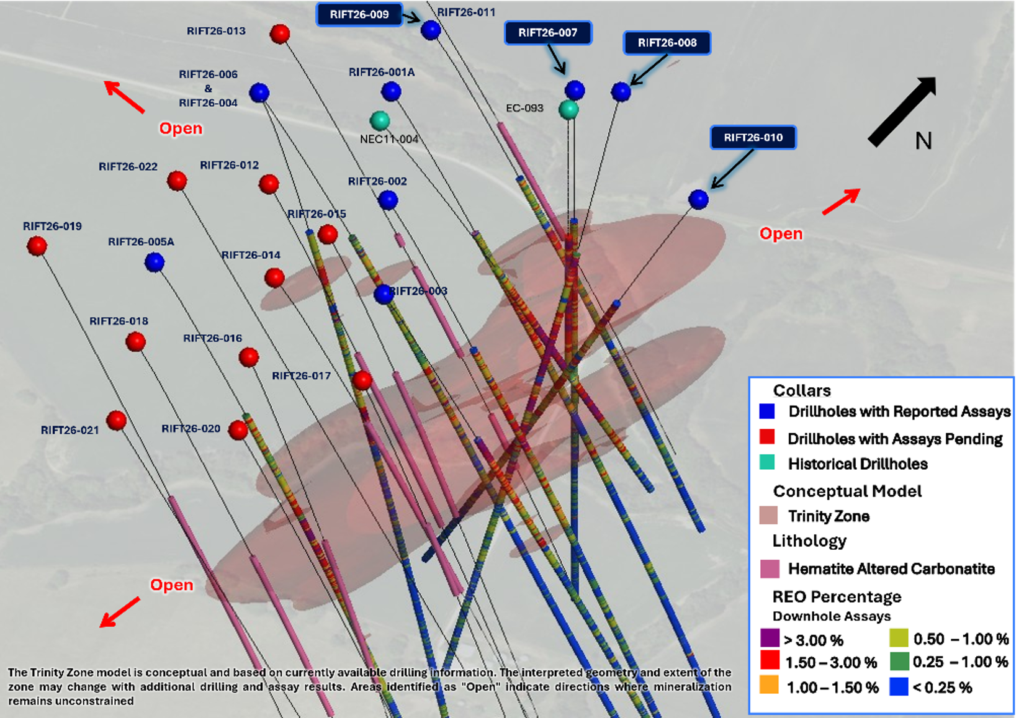
Drilling at the Rift Rare Earth Project continues to confirm broad REO mineralization and high-grade zones:
RIFT26-008: 191.9 m at 2.63% REO, including 52.2 m at 3.54% REO and 12.3 m at 5.63% REO.
RIFT26-010: 239.7 m at 1.62% REO, including 72.6 m at 2.03% REO, 30.2 m at 3.08% REO and 14.9 m at 5.09% REO.
RIFT26-005A: 137.2 m at 2.01% REO, including 80.0 m at 2.51% REO, 23.1 m at 3.47% REO and 11.0 m at 4.39% REO.
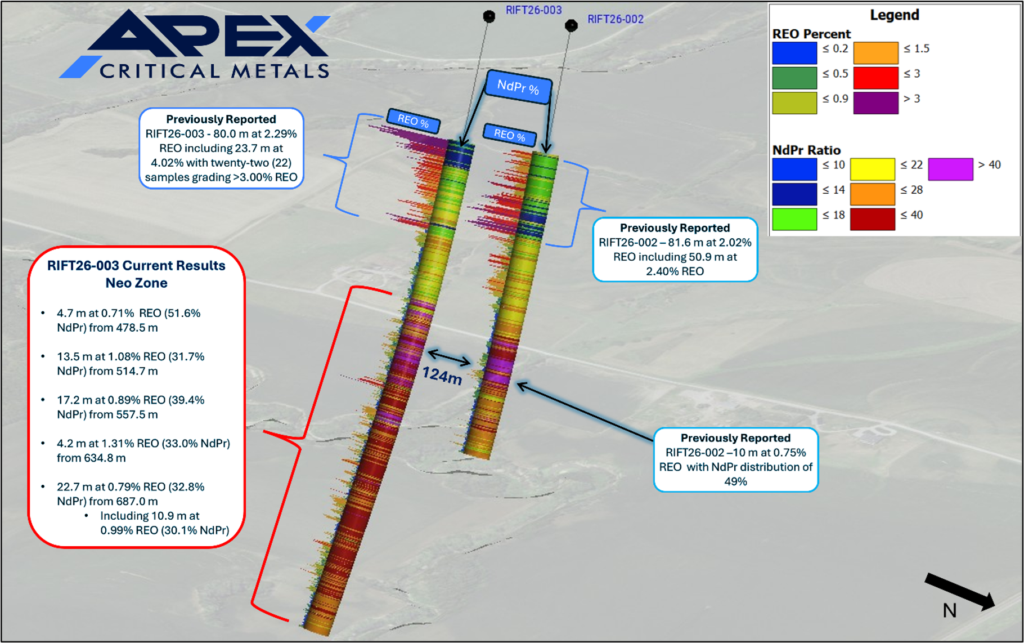
RIFT26-003: 124.0 m at 1.94% REO, including 80.0 m at 2.29% REO and 23.7 m at 4.02% REO.
RIFT26-002: 81.6 m at 2.02% REO, including 50.9 m at 2.40% REO.
RIFT26-007: 68.5 m at 2.48% REO.
RIFT26-009: 51.2 m at 1.65% REO, including 22.2 m at 2.44% REO.
RIFT26-006: 210.0 m at 1.33% REO, including 43.8 m at 2.75% REO and 34.1 m at 3.05% REO.
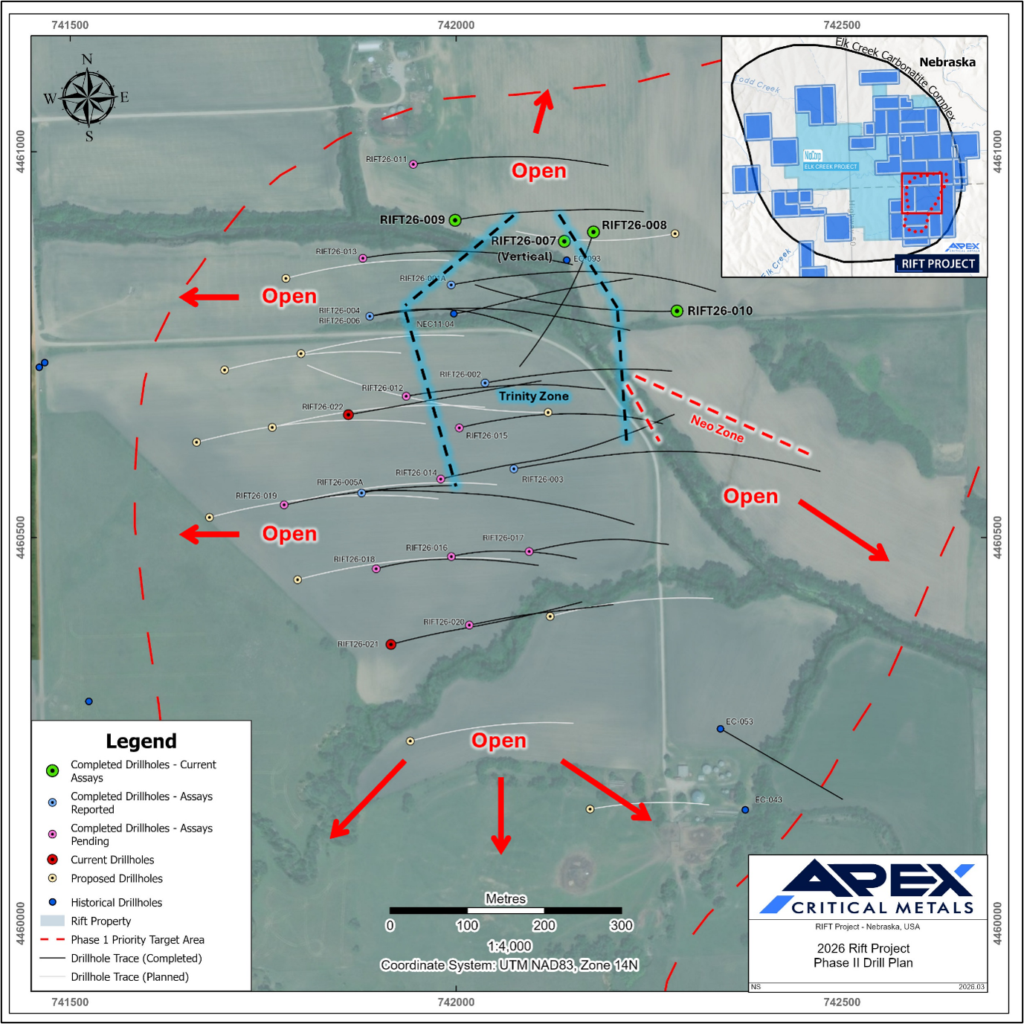
2026 drilling continues to confirm and expand the upper Trinity Zone.
RIFT26-008 extended strong mineralization approximately 400 m down-dip and 50 m south.
RIFT26-010 extended mineralization approximately 120 m east from the historical discovery area.
The Trinity Zone is now defined over more than 380 m of strike within a broader 700 m target corridor.
Mineralization remains open in multiple directions, with additional step-out drilling planned.
For more information, please see news release dated June 22, 2026.
Neo Zone
The Neo Zone represents a second mineralized horizon at Rift with elevated NdPr results.
The zone sits outside the main Trinity Zone and adds potential for a broader multi-zone REO system.
Together, the Trinity and Neo zones support district-scale exploration upside within the Elk Creek Carbonatite Complex.
For more information, please see news release dated May 6, 2026
STRATEGIC OPPORTUNITY
Strategic Opportunity
With large portions of the carbonatite untested using modern methods, the Rift RE Carbonatite offers a unique opportunity to advance critical minerals exploration in the United States. The combination of strong historic results, underexplored REE targets, and favorable jurisdiction makes it a compelling addition to any exploration portfolio.